Chicago Bicycle
Accident Lawyer
Accident Lawyer
Injured in a Bicycle Accident? We Can Help.



Milwaukee Avenue is one of Chicago’s most heavily used bike corridors, running from the city’s northwest edge near Devon Avenue through neighborhoods like Portage Park, River West, and Wicker Park.
Known as Chicago’s busiest cycling route, it connects riders to downtown and major transit lines, making it a favorite among commuting cyclists and messengers. Its layout and access to bike lanes make it a key part of the city’s transportation network, but also a hotspot for crashes.
With frequent bike lane obstructions, protected bike lanes that are often ignored, and high volumes of northbound traffic, a Milwaukee Avenue bike accident can happen when cyclists are forced to leave the bike lane or interact with turning and merging vehicles. If you’ve been hit, injured, or forced into traffic because of a blocked lane or reckless driver, a Chicago bike accident attorney can help you recover compensation and understand your legal rights.
If you were injured in a crash, call (312) 646-3708 to discuss your options in a free consultation.
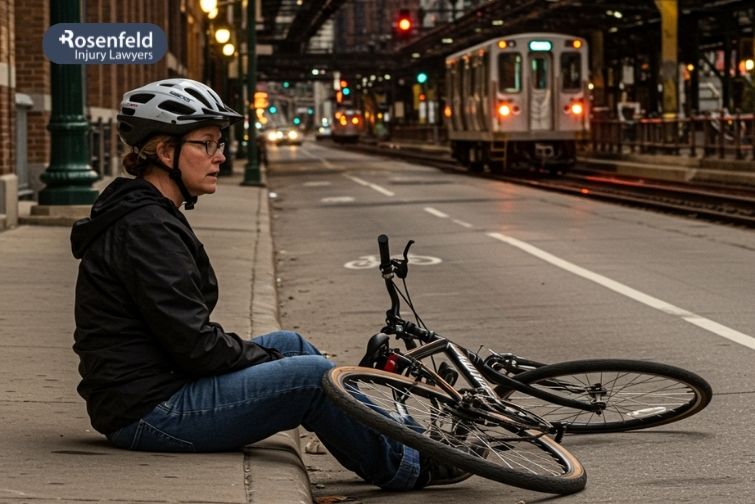
Milwaukee Avenue can be challenging for cyclists because of heavy traffic, bike lane obstructions, turning vehicles, and sections where cyclists must interact closely with motor vehicle traffic. These conditions can increase the risk of dooring, sideswipes, right-hook collisions, and crashes involving vehicles that enter or block the bike lane.
Milwaukee Avenue is often called Chicago’s busiest bike lane, but many cyclists argue it’s also one of the most dangerous. The street cuts through neighborhoods like Wicker Park, West Town, and River West, and while it’s part of the city’s arterial cycling hub, its design creates constant hazards.
Parts of Milwaukee Avenue’s bike lane system lack proper separation from traffic. Even where protected bike lanes are separated by posts or curbs exist, drivers routinely ignore them, using them as loading zones or parking spots.
Many cyclists report daily conflicts with delivery trucks, rideshare vehicles, and city cleanup crews. These violations are so common that activists have launched initiatives like Bike Lane Uprising, a bike lane activist group that tracks and reports bike lane obstructions. Rather than claiming that 2023 set a record for bike lane obstructions or tickets, the page should note that bike lane obstruction and inconsistent enforcement remain concerns along the corridor unless a current city source supports the original claim.
One notorious stretch is the busy Wicker Park intersection near North, Damen, and Milwaukee, where multiple cyclists have been hit or forced into northbound traffic lanes. The area around West Erie Street has also been the site of repeated crashes, including a fatal hit-and-run crash that led to a ghost bike dedicated to the victim.
Published reporting identifies ghost bike memorials on Milwaukee Avenue, including memorials connected to cyclists killed along the corridor. If the page specifically identifies the West Erie Street memorial, verify that location before publication.
The layout of Milwaukee Avenue, with its mix of parked cars, sudden merges, and unclear signage, contributes to frequent bike lane crashes. Some intersections lack visibility, while others see drivers turning without checking the bike lane, putting cyclists at direct risk.
Riders and safety advocates have called for stronger enforcement, safer intersection design, and better protection for people biking along the corridor.
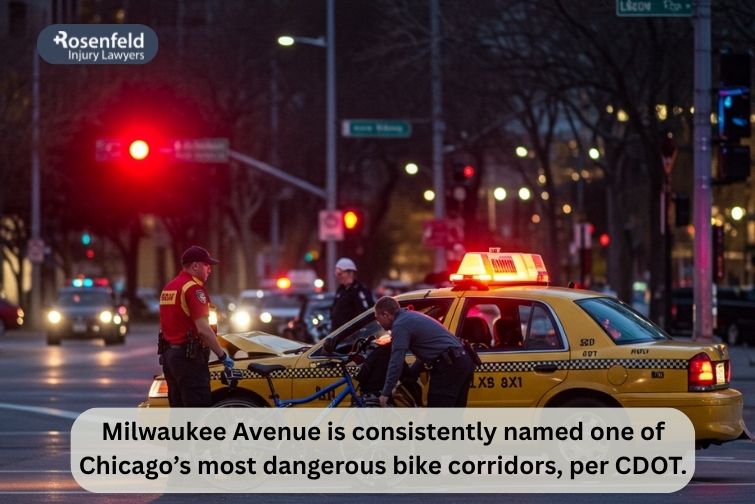
Cyclists involved in accidents often suffer serious injuries due to the street’s dangerous conditions and daily conflicts with drivers. Some of the most common injuries reported include:
These injuries frequently result from predictable patterns along Milwaukee Avenue, where bike lanes, whether marked or protected, are routinely ignored or blocked.
One of the most common crash types is dooring, which occurs when an occupant opens a parked vehicle door into a cyclist’s path. This is especially likely near older sections like the North Avenue bike lane or the block of Milwaukee Avenue, where drivers park close to the curb.
Sideswipes and right-hook turns also lead to crashes when cars overtake a cyclist and turn abruptly without yielding. A right-hook crash occurs when a motorist turns right across the path of a cyclist traveling straight. These situations often happen during rush hour, when northbound traffic lanes are crowded and drivers cut across Milwaukee Avenue bike lanes to turn or park.
In busy city streets, riders must frequently swerve around parked cars or delivery trucks, increasing their exposure to moving traffic. Even a slight miscalculation can lead to a crash and an emergency room visit with costs many aren’t prepared to handle.
Cycling advocates and groups like Bike Lane Uprising have documented these repeated hazards, underscoring how Milwaukee Avenue’s dangerous bike lane conditions contribute to crashes and injuries among daily commuters and recreational riders alike.
Milwaukee Avenue is a key part of the Chicago Bike Network and is formally recognized by the Chicago Department of Transportation (CDOT) as a central corridor in the city’s cycling infrastructure. Yet despite being labeled “Chicago’s busiest bike lane,” the protections for cyclists along this stretch are often minimal or inconsistently enforced.
Additionally, § 9-40-060 prohibits motorists from driving or parking in designated bike lanes unless an applicable exception permits it. The ordinance generally prohibits driving on or parking in an on-street bicycle lane in a manner that impedes bicycle traffic, subject to stated exceptions.
Additionally, § 9-40-060 prohibits motorists from driving or parking in designated bike lanes unless they are turning or avoiding an obstruction, and only if it’s safe to do so. However, enforcement of this rule is spotty, and the city has issued thousands of bicycle lane violation tickets, especially on Milwaukee Avenue, where obstructed bike lanes are an everyday issue.
Milwaukee Avenue features a mix of unprotected and barrier-protected bike lanes, depending on the block. CDOT has installed protected bike lanes separated by plastic bollards or curbs in high-traffic areas, but many installations end abruptly or wear down from constant vehicle contact.
According to CDOT’s Citywide Bikeways Plan (2023), Milwaukee Avenue remains a priority for further improvements, especially through Wicker Park, West Town, and up to Irving Park and Chicago’s northern border.
Despite being a focal point in the citywide cycling infrastructure plan, cyclists continue to report unsafe conditions and bicycle lane violations along this corridor, highlighting the need for stronger enforcement and better design.
For more information about Chicago’s bike lane rules, see Chicago bike lane laws.
Determining fault in Milwaukee Avenue bike accidents can be legally complex, especially given the constant interaction between cyclists, drivers, pedestrians, and parked vehicles along this high-traffic corridor. Unlike some quieter residential areas, Milwaukee Avenue presents layered risks that often blur the lines of liability.
One common scenario involves drivers turning right across the bike lane without yielding to cyclists traveling straight.
These right-hook turns often happen at busy intersections like Wicker Park, where drivers focus on oncoming traffic or pedestrians, not the cyclist beside them. Even if the bicycle lane is clearly marked, a driver may claim the cyclist was speeding or “came out of nowhere,” shifting blame.
Parked cars opening doors into the bike lane, also known as dooring, is another major cause of crashes. In these cases, the person who opened the door is typically at fault under Illinois law, which requires vehicle occupants to check for traffic before opening a door into the path of moving vehicles, including bikes.
Then there’s the issue of bike lane obstructions. If a delivery truck parks in the bicycle lane, forcing a cyclist into the northbound traffic lane, and a crash follows, the driver who strikes the cyclist and the vehicle or person responsible for the obstruction may each become relevant to a liability investigation. Chicago Municipal Code § 9-40-060 prohibits conduct that impedes bicycle traffic in designated bike lanes. A citation, police report, photograph, video, or logged obstruction report can provide evidence, but it does not by itself establish legal liability.
Some blocks of Milwaukee Avenue also include alleyways and side streets where drivers pull out without complete visibility. If a car suddenly exits an alley and strikes a cyclist, the driver is often presumed at fault, but if the cyclist was riding on the sidewalk or against traffic, partial blame may be assigned.
Because of these complexities, cyclists injured in a Milwaukee Avenue bike accident should consult a Chicago bike accident attorney to fully understand their rights.
If you’re involved in a bike accident on Milwaukee Avenue, what you do in the moments and days after the crash can have a significant impact on your recovery, both physically and financially. Here are the key steps every cyclist should take:
Even if injuries seem minor, always report the crash to the Chicago Police. Ask that an official report be filed, especially if the driver left the scene or there are signs of bike lane violations. A police report helps establish what happened and serves as critical documentation if you pursue a legal claim. For additional guidance, see how to file a police report after a bicycle accident.
Go to the nearest emergency room, such as Humboldt Park Health (formerly Norwegian American Hospital), or another nearby facility, depending on your location. Injuries like concussions, fractures, and spinal trauma aren’t always visible right away, and having medical records in place supports your case.
Take photos of your bike, the bicycle lane where the crash occurred, the vehicle, license plates, and any obstructions like parked cars or delivery trucks. Include damage, road conditions, and any signage (or lack of it) that may have contributed to the crash.
If anyone saw the crash, ask for their name and number. Witnesses can help establish fault, especially in hit-and-run crashes or disputes over lane use.
The driver’s insurance may call soon after the incident. Do not provide a recorded statement without legal advice. They may use your words to reduce or deny your claim. For help after a Milwaukee Avenue bike accident, contact a Chicago bike accident attorney who can protect your rights and guide you through the following steps.
If you’ve been injured in a Milwaukee Avenue bike accident, working with a Chicago bicycle accident lawyer can make a significant difference in how your case is handled and how the available evidence is evaluated. Cyclists are often blamed unfairly or pressured into quick settlements. A lawyer steps in to protect your rights and make sure your story is backed by evidence.
An experienced attorney will conduct a thorough investigation. This may include collecting video footage, speaking with witnesses, reviewing Chicago Police reports, and analyzing how bike lane violations, parked cars, or driver negligence contributed to the crash. On a corridor like Milwaukee Avenue, where bicycle lane obstructions are routine, this step is critical to identifying all at-fault parties.
Insurance adjusters may act like they’re on your side, but their job is to minimize payouts. A lawyer communicates directly with the driver’s insurer, protects you from lowball offers, and prevents your words from being used against you.
Time-sensitive evidence like street camera footage, eyewitness accounts, and photos of the bike lane conditions can disappear quickly. Your lawyer will move quickly to preserve this material, helping build a strong liability case.
Beyond medical bills, injured cyclists often face lost income, bike repairs, ongoing therapy, and emotional stress. A lawyer will calculate the full impact of your injuries and fight for compensation that reflects what you’ve truly lost, not just what insurance offers up front.
Whether you were injured near West Erie Street, the North Avenue bicycle lane, or the Wicker Park stretch, legal help can ensure your recovery isn’t sidelined by paperwork, red tape, or blame-shifting.
Identify the highest-risk locations using the most current, reliable crash data available for the corridor. Published reporting has identified areas around North, Damen, and Milwaukee, as well as other intersections along Milwaukee Avenue, as locations of concern. Verify the specific locations against current crash data before publication.
A blocked bike lane can become important evidence in determining bicycle crash liability. Chicago Municipal Code § 9-40-060 generally prohibits vehicles from driving, standing, or parking in designated bike lanes in a manner that impedes bicycle traffic, subject to exceptions. Preserve photographs of the obstruction, the vehicle’s markings and license plate, and the locations of nearby cameras as soon as possible.
If a motor vehicle was involved, reporting the crash can create important documentation of what happened. Call 911 when appropriate and ask how to obtain the resulting report; you can also review our guide on how to file a police report after a bicycle accident.
Yes. Ghost bike memorials have been installed at several locations along Milwaukee Avenue to honor cyclists who were killed in crashes, including a memorial for Sam Bell in River West. If this page identifies a specific memorial location, verify the location and cyclist’s name before publication. For more information, see ghost bikes in Chicago.
If you were injured on Milwaukee Avenue, you don’t have to face the aftermath alone. This busy corridor is known for its dangerous traffic, obstructed bike lanes, and daily hazards that put cyclists at risk. Our team at Chicago Bike Injury Lawyers understands the specific challenges riders face on this stretch, from Wicker Park to Irving Park, and we’re here to help.
We’ll investigate the crash, secure key evidence, and handle the insurance companies while you focus on healing. Whether it was a dooring incident, a hit-and-run, or a bike lane violation, we’ll fight for the compensation you deserve. For information about another major Chicago cycling corridor, see our Ashland Avenue bike accidents guide.
Call (312) 646-3708 or fill out our contact form to schedule a free consultation with an experienced Chicago bike accident attorney. Let us stand up for you and your recovery.
 Legally Reviewed By
Attorney Jonathan Rosenfeld
Reviewed by Attorney Jonathan Rosenfeld The material on this page has been legally reviewed by Attorney Jonathan Rosenfeld of Rosenfeld Injury Lawyers LLC. Mr. Rosenfeld and his team have experience representing injured cyclists in bicycle accident cases in Chicago. With a focus on personal injury law, they help bicycle accident victims understand their legal options and pursue compensation for medical expenses, lost wages, and other damages resulting from their injuries.