
Chicago Bicycle
Accident Lawyer
Accident Lawyer
Injured in a Bicycle Accident? We Can Help.



Bicyclists in Chicago must understand both Illinois bicycle laws and Chicago-specific ordinances in order to stay safe and avoid legal consequences on the road. Not following proper Illinois traffic and bike safety laws can result in devastating accidents or costly legal fines.
With many variations in bicycle traffic laws from state to state, the best way to learn and observe these laws before disaster strikes is to break them down into simple terms. If you have questions about how these laws apply after a crash, Chicago bicycle injury lawyers can help explain your legal rights and options.
It can be frightening and alarming to be involved in a bicycle accident. Regardless of circumstances or fault, it’s imperative to have a skilled and experienced legal team on your side. Our Chicago bike crash lawyers can help you protect your rights in the aftermath of an accident.
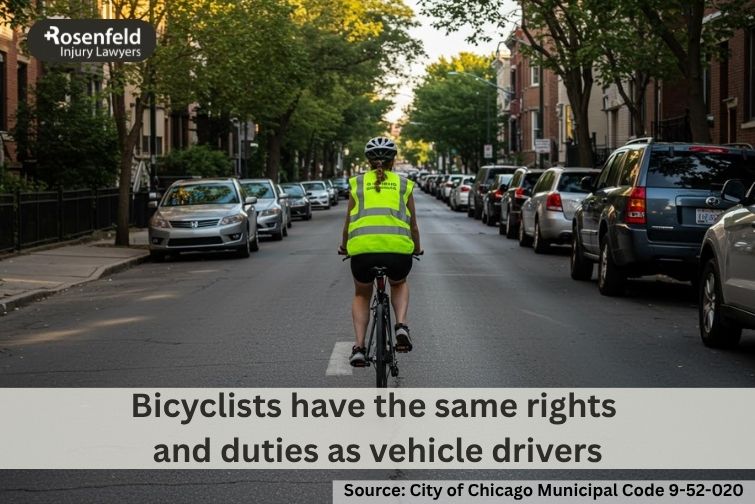
Chicago bike riders must obey Illinois traffic laws when on the road. Numerous state-level traffic laws pertain to bicyclists in Chicago and throughout the state of Illinois. If a violation leads to an accident, it is also helpful to understand how bicycle accident lawyer fees work before seeking legal representation.
Under Illinois vehicle code (625 ILCD 5/), bicycles are considered vehicles. Therefore, they must have the same rights and duties as motorists on the road, with some specific exceptions, such as crosswalk usage.
“The regulations in the traffic code applicable to bicycles shall apply whenever a bicycle is operated upon any roadway or public sidewalk or upon any public path set aside for the use of bicycles, subject to those exceptions stated herein.” Riders should also understand bicycle insurance requirements in Illinois to better protect themselves in the event of an accident.
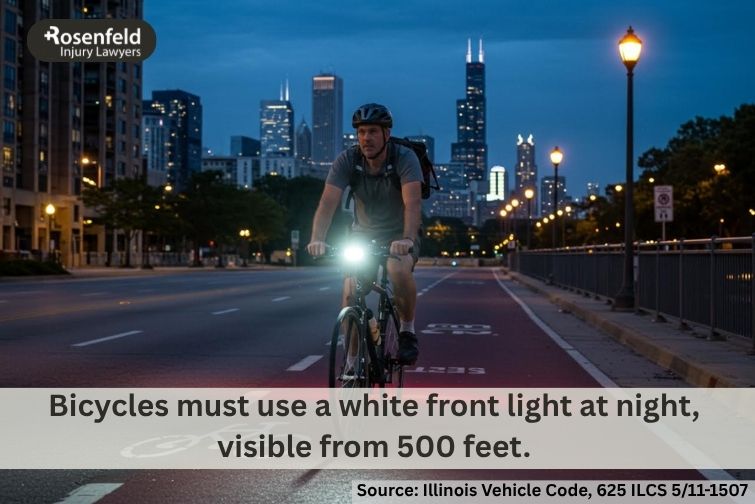
According to Illinois state law (625 ILCS 5/11-1507), bikes must always be equipped with certain features for safety.
When riding a bicycle on a roadway, the presence of bike paths, sidewalks, and multiple lanes can make navigating tricky.
Cyclists must generally obey the same traffic laws as other motorists.
Under Chicago Municipal Code 9-52-110, cyclists are prohibited from using a mobile communication device, such as a cell phone, digital assistant, or mobile computer while operating the bike with a few exceptions:
No, you cannot get a DUI on a bicycle in Illinois. Under Illinois DUI laws, bicycles are not considered vehicles, so DUI statutes do not apply. There are currently no laws prohibiting biking under the influence in Illinois, though it remains unsafe and riders can still be held civilly liable for accidents they cause while impaired. Operating a bicycle while under the influence of alcohol is not recommended for safety of yourself and those around you, but there are no specific DUI statutes that apply. If you have questions about liability after an impaired cycling accident, our Chicago bicycle injury lawyers are available to help.
In Illinois, bicycles must stop at stop signs and red lights. Illinois does not follow the “Idaho Stop” law, which in some states allows cyclists to treat stop signs as yield signs and red lights as stop signs. In Illinois, full stops are required just like for motorists. You can also review e-bike related injury data to better understand the risks associated with traffic law violations.
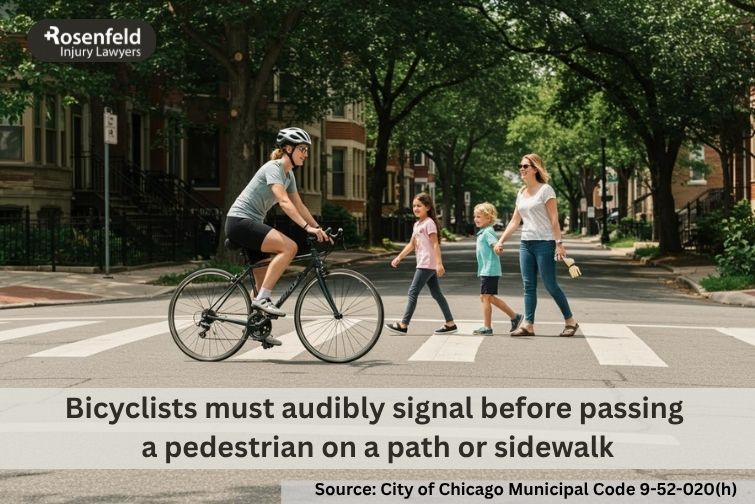
The city of Chicago has specific ordinances to protect cyclists, pedestrians, and drivers from accidents.
Bicycles are not required by law to be registered by the state. Many ordinances encourage registration, including Chicago, as it can help track stolen bicycles by law enforcement. Riders should also familiarize themselves with Illinois sidewalk cycling laws, which vary depending on where they ride.
In Chicago, parked motor vehicles must check for bicycle and pedestrian traffic before opening their car door. According to ordinance 9-80-035, doors should not open to the side of traffic until it is reasonably safe to do so and should not remain open longer than necessary to load and unload passengers.
Obstructing the path with a car door that causes a violation of the dooring ordinance is subject to a $1,000 fine for each offense.
In Chicago, a bicycle mustn’t carry more passengers than the bike is designed for. There is an exception for cyclists carrying an infant in a sling or backpack only.
According to state law (625 ILCS 5/11-1513), parking your bicycle in Chicago must not impede any motor vehicle, bicycle, or pedestrian traffic. Bikes are allowed to be parked on the sidewalk unless otherwise prohibited by traffic control signage or personnel.
Bikes can also be parked individually or abreast one another on roadways “at any angle to the curb or the edge of the roadway” where parking is legal. However, bikes cannot obstruct any parked motor vehicle from moving. Any highway parking must adhere to all parking laws regarding highways. Riders of electric bicycles should also be aware of e-bike age requirements before using public roads.
Bicycles can be towed or impounded when abandoned in any public way within the city of Chicago. Bikes are considered to be abandoned when they are in such disrepair that they cannot be operated or show other signs of abandonment, such as not being moved within seven days.
The Department of Transportation will affix a notice to an abandoned bicycle, and if no action is taken within seven days of the notice, the bike can be removed. While sharing the road, motorists must also comply with the safe passing distance law for cyclists to help prevent collisions.
Violating bicycle-related ordinances in Chicago can accrue hefty fines or even arrests depending on the violation and criminal history. Some violations, such as failure to yield right-of-way to a bicycle when turning, can accrue fines of $150.00. Other ordinances, such as dooring ordinances, are subject to $1,000 fines.
Obstructing bike lanes can accrue fines of up to $250. Reckless driving that results in serious injury or death of a bicyclist can even result in criminal charges as serious as felonies. Drivers should also understand the Illinois dooring law to avoid preventable accidents involving cyclists.
Cyclists may also pursue personal injury or property damage claims against violators of bicycle ordinances that cause accidents, causing further financial consequences. Understanding Illinois bicycle safety laws can help both cyclists and motorists avoid preventable crashes.
When operating a motor vehicle, drivers have a duty to drive responsibly, including avoiding bicyclists when applicable.
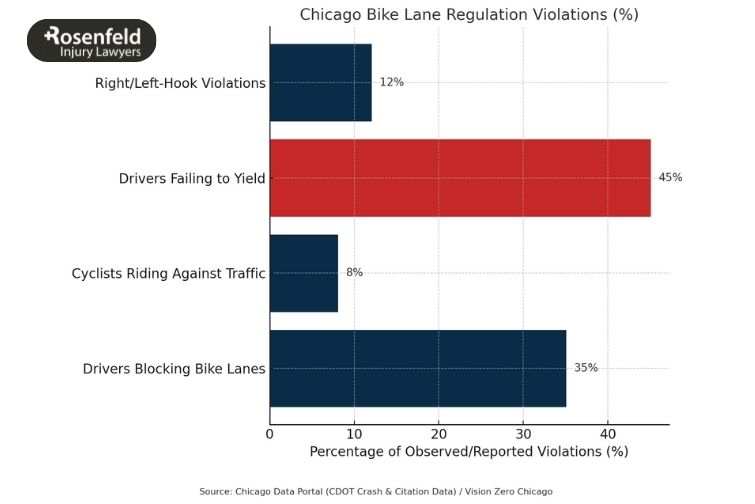
Chicago cyclists need to stay safe and responsible on the road by learning their rights, Chicago laws, and safety regulations. Helpful organizations and resources include:
Bicycle accidents can be terrifying, but damages can be mitigated when practical safety advice is followed.
Our Illinois bike crash lawyers have represented thousands of clients with success, including bicycle accident victims. We can help you file insurance claims, understand your rights, represent you in court, and recover damages from bicycle accidents. Consultations are entirely free to discuss your case. You don’t need to worry about fees unless your case is won!
Yes. In Illinois, cyclists must come to a complete stop at stop signs, just like motorists. Illinois does not follow the “Idaho Stop” law, which in some states lets cyclists treat stop signs as yield signs. Running a stop sign on a bike can result in a citation and may affect fault if an accident follows.
Yes, with conditions. Under the Chicago Municipal Code, two cyclists may ride side by side on roadways as long as it doesn’t impede the “normal and reasonable movement of traffic.” On bike paths with enough room, more than two abreast is permitted. Cyclists must switch to single file when a motorist needs to safely pass.
No. Illinois DUI laws apply only to motor vehicles, and bicycles are not classified as vehicles under the DUI statute. There is currently no law against biking under the influence in Illinois. That said, an impaired cyclist can still be found civilly negligent for causing an accident.
Yes. Cyclists in Illinois must obey red lights, just like motorists. Illinois does not have a “dead red” law that would allow cyclists to proceed through a non-functioning traffic signal. Running a red light on a bike can result in a citation.
Generally yes. Under the Illinois Vehicle Code, bicycles have the same rights and duties as motor vehicles on the road, with a few specific exceptions (such as certain crosswalk rules). Cyclists must yield to pedestrians, signal turns, stop at signals and stop signs, and follow lane-use rules.
Mostly yes. In Chicago, riding on sidewalks is generally prohibited unless the sidewalk is designated as a bicycle route, or you are crossing it to reach the nearest roadway or a bike-share station. Violations can result in fines.
 Legally Reviewed By
Attorney Jonathan Rosenfeld
Reviewed by Attorney Jonathan Rosenfeld The material on this page has been legally reviewed by Attorney Jonathan Rosenfeld of Rosenfeld Injury Lawyers LLC. Mr. Rosenfeld and his team have experience representing injured cyclists in bicycle accident cases in Chicago. With a focus on personal injury law, they help bicycle accident victims understand their legal options and pursue compensation for medical expenses, lost wages, and other damages resulting from their injuries.