Chicago Bicycle
Accident Lawyer
Accident Lawyer
Injured in a Bicycle Accident? We Can Help.



If you need to know how to avoid bicycle dooring accidents, Chicago is a great place to learn.
To avoid dooring in Chicago, stay outside the door zone, watch parked vehicles for signs of occupants, and adjust your position when a bike lane is too close to parked cars.
Chicago has made infrastructure changes to improve bicycle safety, but cycling still involves risks. If you get hurt in a bicycle dooring accident, a Chicago bike accident lawyer from our team can guide you through the claims process to earn compensation.
One of the main causes of bike accidents in large cities like Chicago is dooring. Dooring is a collision that occurs when a motor vehicle occupant opens a door into the path of a bicycle rider. Although dooring accidents typically occur with parked cars, they can also occur when a vehicle is at an intersection or in slow-moving traffic.
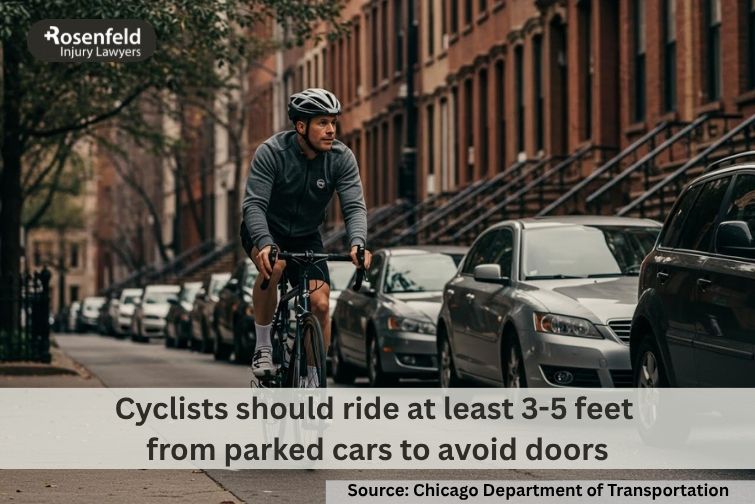
To understand how to avoid dooring in Chicago, ride at least three to four feet from parked cars, outside the door zone. Scan through rear windows and side mirrors for occupants, slow down past tightly parked blocks, and take the travel lane when the bike lane sits inside the door zone.
A bicycle dooring accident can be incredibly dangerous for the rider, even at low speeds. When a car door hits a biker, their only protection may be a helmet and some protective clothing. Otherwise, the vehicle shell does not protect the rider from blunt-force trauma, internal organ damage, road rash injuries, or other severe injuries.
Therefore, dooring accidents can have significant consequences for the oncoming cyclist. The unexpected collision could cause the rider to hit the car door directly or swerve into other obstacles to avoid the crash.
The door zone is the three- to four-foot area beside parked vehicles that an opening car door can reach. In Chicago, some painted bike lanes run close to parked vehicles, so staying inside the lane does not automatically keep a cyclist outside the door zone.
Maintain at least three to four feet of space from parked cars when practical. If a bike lane is too narrow to provide that buffer, move farther left or use the travel lane when reasonably necessary. Illinois law permits cyclists to move away from the right-hand curb to avoid parked or moving vehicles and substandard-width lanes under 625 ILCS 5/11-1505(a)(3). See our Chicago bicycle accident statistics.
Protected and curbside-protected bike lanes can reduce exposure to opening doors. Pay particular attention around Milwaukee Avenue, Clark Street, Dearborn Street, and Halsted Street.
Illinois dooring law prohibits opening a vehicle door on the side available to moving traffic unless it is reasonably safe and can be done without interfering with other traffic. Chicago Municipal Code 9-80-035 contains a similar rule and applies to the person opening the door, including a driver or passenger.
Chicago Municipal Code 9-4-025 provides a $300 fine when a violation interferes with bicycle movement and a $1,000 fine when it causes a collision between a motor vehicle and a bicycle.
A dooring violation may be evidence relevant to a negligence claim, but responsibility depends on the facts. See our Illinois dooring law resource and Chicago bicycle laws.
Chicago’s dooring rules are also relevant to Dennis’ Law, which protects vulnerable road users.
Illinois also teaches the “Dutch Reach“. Since January 2019, state law has required the Secretary of State to include the technique in the Illinois Rules of the Road manual and add bicycle-safety questions to the driver’s license exam question pool. The Dutch Reach means opening your door with your far hand, which turns your body toward the bike lane. It is a taught best practice, not a separate legal requirement.
Chicago bicycle laws also address bicycle equipment. Use headlamps and reflectors at night, as required by municipal code 9-52-080.
Whether you ride in bike lanes, marked sidewalks, or shared roadways, you can take steps to lower your risk of a bicycle dooring accident.
First, ride defensively and try to anticipate potential hazards. Wear bright and visible clothing to increase your chances of being seen by vehicle occupants.
Use headlamps and reflectors at night, as per municipal code 9-52-080. Maintain at least three to four feet of distance from parked cars to stay outside the door zone. When the bike lane is too narrow to provide that space, move farther left or use the travel lane when reasonably necessary to avoid parked vehicles.
For cyclists learning how to avoid dooring in Chicago, scan parked vehicles for people inside. Look through rear windows, watch for movement, and slow down when a vehicle appears occupied. If you notice someone about to open a vehicle door, use your bell or voice to alert them when it is safe to do so.
If a painted lane places you inside the door zone, changing your road position can be safer than following the stripe.
As a motorist or passenger in a car, you are responsible for preventing dooring collisions with bikers. Always check for oncoming traffic and bicyclists before opening the car door. Use the “Dutch Reach” method to force yourself to turn and check those blind spots.
If you are the driver, warn your passengers to check for an oncoming cyclist before exiting the vehicle, especially if you are parked next to designated bike lanes. Rideshare drivers and passengers should take the same precautions. Before opening a door into traffic, check mirrors and look for approaching bicyclists. Rideshare bicycle collisions can occur when a passenger opens a door into a cyclist’s path.

Even if you follow all the tips to avoid a dooring collision, these accidents are sometimes inevitable. Some people simply don’t pay attention when opening car doors. If you get hurt from a bicycle dooring accident, here are some steps to follow as the cyclist:
If you are the passenger or driver involved in the collision, this is what you should do:
Illinois law requires notice to police when a crash results in injury or death, and other reporting requirements can apply when property damage exceeds the statutory threshold. If you are injured, request a police report and obtain the report or RD number if one is created.
If you need help after a dooring crash, call 312-646-3708 or contact our team for more details.
As an injured bicyclist in a dooring accident, you may have the right to pursue compensation for legal damages. You must be able to prove that someone else’s negligence caused the accident and, therefore, your suffering.
To establish liability, you need evidence of a duty of care, breach, causation, and damages. Evidence may include photographs, witness statements, medical records, and a police report.
You could be eligible for compensation for lost wages, medical expenses, property damage, emotional distress, pain and suffering, and loss of quality of life. Learn more from a Chicago dooring accident lawyer.
For cyclists learning to avoid dooring in Chicago, keep at least three to four feet of buffer from parked cars. Illinois law also allows a cyclist to move left when reasonably necessary to avoid parked vehicles or a lane too narrow to share.
Yes. Illinois law and Chicago Municipal Code 9-80-035 prohibit opening a vehicle door on the side available to moving traffic unless it is reasonably safe and does not interfere with traffic. MCC 9-4-025 provides fines of $300 or $1,000 depending on the circumstances.
The person who opens the door may be responsible, but liability depends on the facts. The rule applies to drivers and passengers.
The Dutch Reach means opening a vehicle door with your far hand so your body turns toward the door. Illinois requires guidance about the technique in the Rules of the Road and bicycle-safety questions in driver testing, but the technique is not a separate legal requirement.
Police reporting depends on the circumstances. Illinois requires notice when a crash results in injury or death. If injured, call police, request a report, and obtain the report or RD number if one is created.
A personal injury action in Illinois generally must be commenced within two years under 735 ILCS 5/13-202. Different deadlines can apply to government claims or other special circumstances.
An experienced bicycle accident law firm can help you understand your legal options after a serious injury. Our team can assist with the legal logistics so you can focus on recovering from your injuries. Contact us today to schedule a free legal consultation with a bike accident lawyer serving Illinois.
 Legally Reviewed By
Attorney Jonathan Rosenfeld
Reviewed by Attorney Jonathan Rosenfeld The material on this page has been legally reviewed by Attorney Jonathan Rosenfeld of Rosenfeld Injury Lawyers LLC. Mr. Rosenfeld and his team have experience representing injured cyclists in bicycle accident cases in Chicago. With a focus on personal injury law, they help bicycle accident victims understand their legal options and pursue compensation for medical expenses, lost wages, and other damages resulting from their injuries.