- Free Consultation: 312-646-3708 Tap Here To Call Us




How Truck Blind Spots Endanger Chicago Cyclists


That uneasy feeling you get riding next to a big truck? Trust it. Around a tractor-trailer, you can be completely invisible to the driver. Not because they’re careless, but because the truck is built in a way that hides you.
On Chicago’s truck-heavy streets, knowing where a driver can and can’t see you is core bike safety. Most turning vehicle bicycle collisions happen because a rider sat where the driver couldn’t see. Here’s how truck blind spots endanger cyclists, and how to stay safe.
Why Trucks Are So Much More Dangerous Than Cars
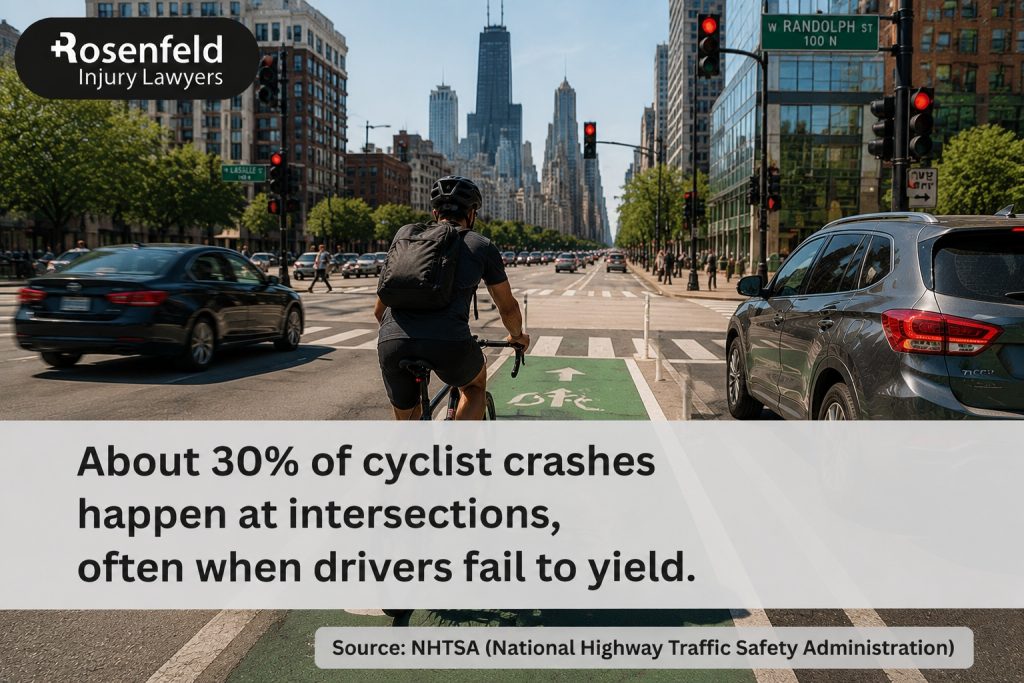
A collision with a car is bad. With a truck, it’s often catastrophic. The math is brutal: a loaded tractor-trailer can weigh up to 80,000 pounds against a cyclist’s 200 or so. There’s no fair contest.
Size changes everything. A semi-truck needs up to two football fields to stop at highway speed, so a driver who sees you late often can’t stop in time. Trucks also sit higher, make a wide right turn, and carry cargo that blocks the view.
That long stopping distance and limited sightline are a dangerous mix. That’s what makes turning vehicle bicycle collisions with trucks so severe.
Where a Truck Driver Can’t See You: The Four No-Zones
The Federal Motor Carrier Safety Administration (FMCSA) calls a truck’s blind spots “No-Zones,” and trucks have four of them:
- The front, roughly 20 feet ahead, where the high cab and long hood hide anyone close in front.
- The rear, about 30 feet behind, where the driver has no mirror to see you at all.
- The left side, along the driver’s door, smaller but still real.
- The right side, the largest and most dangerous No-Zone for cyclists, running the length of the trailer.
The right side is where so many truck-bicycle accidents happen, often as a right hook when the truck turns, because that’s where cyclists tend to ride. The simplest rule: if you can’t see the driver’s mirrors, the driver can’t see you.
The Right-Turn Squeeze: The Deadliest Trap
The most dangerous moment of all is a truck turning right. Because a trailer doesn’t follow the cab in a straight line, it tracks inward, cutting across the space between the truck and the curb. A cyclist on the right side can be squeezed and pinned against the curb as the trailer swings through.
It gets more confusing, because a truck often swings wide left first to set up a tight right turn. A cyclist may read that as the truck moving away and pull up on the right, into the danger zone. These crashes are among the deadliest in city cycling. Most come down to a rider sitting in a blind spot the driver never checked, or never could.
How to Protect Yourself Around Trucks
You can’t fix a truck’s blind spots, but you can stay out of them. A few habits make a real difference:
- Never pass a truck on the right. That’s the biggest No-Zone, and the worst place to be if it turns.
- Wait for a turning truck to finish. Most truck crashes happen mid-turn, so if a truck is signaling or stopped to turn, hang back and let it clear.
- Stay off the curb beside a truck. Don’t slip into the gap between a truck and the curb, that’s the right-turn squeeze waiting to happen.
- Make eye contact. If you can catch the driver’s eyes in their mirror, you know they’ve seen you.
- Be visible. Run a bright front and rear light, even by day, and wear high-visibility clothing to boost your cyclist visibility.
- Give trucks room. Never cut in close in front of one, since they can’t stop quickly.
Who’s Responsible When a Truck Hits a Cyclist
Truck cases are rarely simple, because more than one party may be at fault: the driver, the trucking company (for negligent hiring, training, or pushing past safe hours), the owner, or a parts maker. Federal rules from the FMCSA govern how these commercial truck companies operate, and proving a violation often makes a case. But the evidence, driver logs, maintenance records, electronic data, can disappear fast, which is why acting early matters.
What to Do If a Truck Hits You
If a truck hits you, a few steps protect both your health and your claim.
First, talk to a lawyer before you give any statement to an insurer. Truck cases move fast, and a quick, free call helps preserve the evidence before it’s gone. Then call 911 for a police report, and see a doctor even if you feel okay, since serious injuries can hide at first. If you can, photograph the truck, its company markings and plate, the scene, and your bike, and get any witness names.
The Bottom Line
You can’t shrink a truck’s blind spots, but you can stay out of them. Keep off the right side, never linger beside a turning truck, and make sure the driver sees you before you commit. Those habits prevent most turning vehicle bicycle collisions with trucks.
Talk to Chicago Bike Injury Lawyers
If a truck hit you while riding, Chicago Bike Injury Lawyers can help. Our firm has recovered real results for injured cyclists, and we know how to hold trucking companies and their insurers accountable. The consultation is free, you pay nothing unless we win, and we’re available 24/7. Call 312-646-3708.
Frequently Asked Questions
Where are a truck’s blind spots?
A truck has four No-Zones: about 20 feet in front, 30 feet behind, along the left side, and a large one down the entire right side. The right side is the most dangerous for cyclists.
Why are right turns so dangerous for cyclists near trucks?
When a truck turns right, the trailer tracks inward toward the curb. A cyclist on the right can be trapped and crushed in the gap. These turning vehicle bicycle collisions are among the deadliest in city riding.
Who is liable in a truck-bicycle accident?
Often more than one party. The driver, the trucking company, the vehicle owner, or a parts manufacturer may share fault. Federal trucking regulations frequently play a role in proving the case.
 Legally Reviewed By
Attorney Jonathan Rosenfeld
Reviewed by Attorney Jonathan Rosenfeld The material on this page has been legally reviewed by Attorney Jonathan Rosenfeld of Rosenfeld Injury Lawyers LLC. Mr. Rosenfeld and his team have experience representing injured cyclists in bicycle accident cases in Chicago. With a focus on personal injury law, they help bicycle accident victims understand their legal options and pursue compensation for medical expenses, lost wages, and other damages resulting from their injuries.
Visit Us