- Free Consultation: 312-646-3708 Tap Here To Call Us




How Police Investigate Hit-and-Run Bicycle Accidents


Here’s what most people don’t realize about a hit-and-run: the case is usually won or lost in the first day. The footage that identifies the car gets recorded over. The witness who saw the plate goes home. The debris gets swept up.
Finding hit and run driver leads depends almost entirely on evidence that starts disappearing within hours. That’s the hard part, and it’s why what you do right now matters so much. Here’s how police investigate these cases, and how you can help before the trail goes cold.
What Makes It a Hit-and-Run?
A hit-and-run happens any time a driver hits someone, including a cyclist, and leaves without stopping to identify themselves or help. In Illinois, that’s a crime, not just a traffic matter. Drivers are legally required to stop, exchange information, and render aid, and leaving instead turns an accident into a criminal offense.
That distinction matters because it means the police, not just your insurance company, have a reason to investigate.
What to Do First, Before the Trail Goes Cold
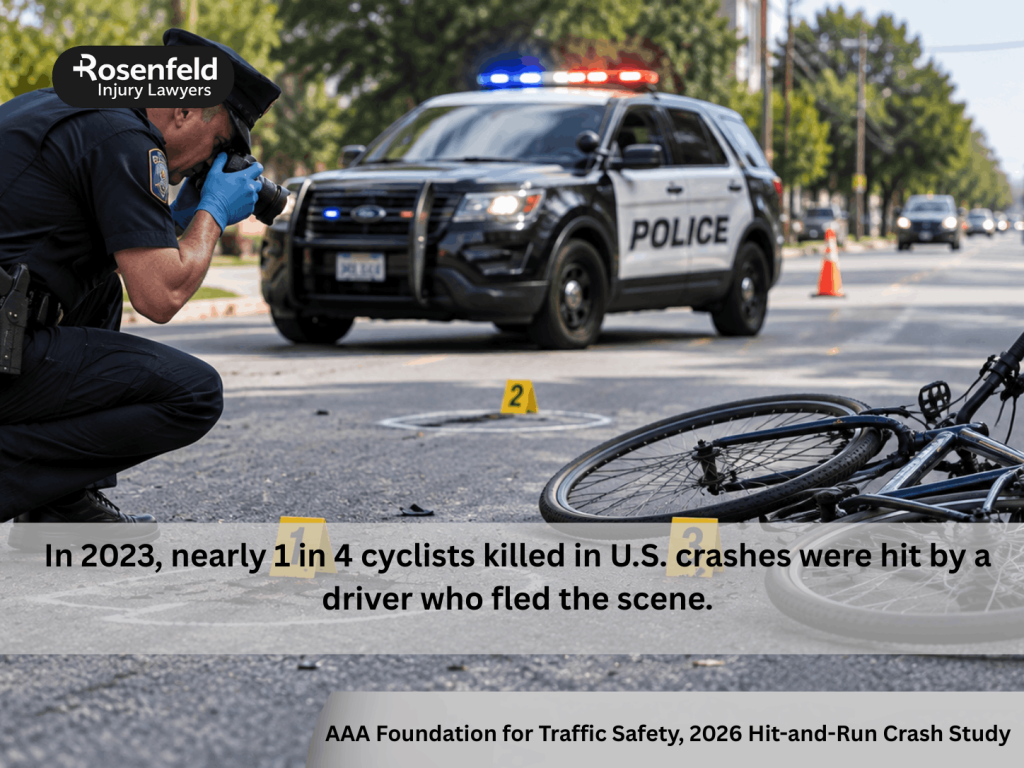
The minutes right after a crash shape the entire investigation. If you’re able, this is where you can help the most:
- Get to safety and call 911. A police report starts the official record.
- Capture what you can about the car. Color, make, model, and any part of the plate. Even a partial plate helps.
- Photograph everything. The scene, your bike, your injuries, and any debris the car left behind.
- Find witnesses. Names and numbers from anyone who saw it, their account can be decisive.
- Get medical care. Your health comes first, and the records also document the crash.
Then talk to a lawyer early. The sooner an investigation begins, the more evidence still exists to find.
Finding Hit and Run Driver: How Police Piece It Together
Finding a hit and run driver comes down to piecing together small clues into one identification. Police draw on several sources:
- Physical evidence at the scene. Broken-off car parts, paint transfer, and debris can reveal a vehicle’s make, model, and color.
- Surveillance and traffic cameras. Officers canvass nearby businesses, homes, and intersections for footage. In a camera-dense city like Chicago, this is often the single most valuable lead.
- Witness accounts. A bystander who caught a plate, a direction of travel, or a clear vehicle description can break a case open.
- Plate and vehicle searches. Even a partial plate, combined with a make and model, can be run through databases to narrow down suspects.
- A lookout alert. Police can circulate a description so other officers know what vehicle and damage to watch for.
No single clue usually cracks it. Identifying a hit and run driver is about combining a partial plate, a paint color, and a camera frame until they point to one car.
What Helps, and What Hurts the Search
Time is the enemy. Surveillance footage gets overwritten, often within days. Witnesses forget details or move on. Debris gets swept away. The faster a crash is reported and the more evidence is preserved, the better the odds of finding a hit and run driver.
That’s why your early documentation matters. A photo of a paint smear or a partial plate you remembered can be the thread that ties everything together.
What If the Driver Is Never Found?
Sometimes, despite everyone’s best effort, the driver simply isn’t identified. That doesn’t always mean you’re left with nothing. In Illinois, the uninsured motorist coverage on your own auto policy can apply even when you’re hurt on a bike.
It covers a hit-and-run driver as if they were uninsured. Many cyclists don’t realize this protection exists, which is one more reason to talk to a lawyer rather than assume the door is closed.
How a Lawyer Can Help
A lawyer doesn’t replace the police investigation, but runs alongside it. We move fast to request and preserve camera footage before it’s erased, track down witnesses, and handle the insurance side.
That includes an uninsured motorist claim if the driver is never caught. We also make sure everything is filed within Illinois’ deadline, generally two years for an injury claim, so your options stay open while the search continues.
Frequently Asked Questions
How do police find a hit-and-run driver?
They build the case from small clues that add up: paint transfer and broken car parts, surveillance and traffic camera footage, witness accounts, and partial-plate searches. In a camera-heavy city like Chicago, nearby footage is often the lead that cracks it.
What should I do right after a hit-and-run on my bike?
Talk to a lawyer early, before you give any statement to an insurer. Call 911 so a police report documents the crash. Note anything you can about the car and plate, and photograph the scene and any debris. Get witness contact information, and see a doctor even if you feel fine.
What if the driver is never caught?
You may still have a path to compensation. In Illinois, the uninsured motorist coverage on your own auto policy can apply even when you are on a bike. It treats a hit-and-run driver as if they were uninsured. It’s worth having a lawyer review your coverage before assuming nothing can be done.
The Bottom Line
Finding hit and run driver leads is hard, but a serious investigation, backed by cameras, witnesses, and physical evidence, succeeds more often than you’d think. The most powerful thing you can do is act fast: report it, preserve every detail, and get help early. And even if the driver is never found, you may still have a path to recovery.
If you were hurt by a hit-and-run driver, we can help. At Chicago Bike Injury Lawyers, we know how to preserve evidence quickly, work alongside the police, and pursue every avenue of compensation. Our consultation is free, you pay nothing unless we win, and we’re available 24/7.
Call us at 312-646-3708.
Visit Us